
Submission Preparation Checklist
As part of the submission process, authors are required to check off their submission's compliance with all of the following items, and submissions may be returned to authors that do not adhere to these guidelines.
- Confirm that the manuscript has been submitted solely to this journal and is not published, in press, or submitted elsewhere. Authors should disclose any prior posting, publication or distribution of all or part of the manuscript to the journal (use Comments for the Editor field below).
- Confirm that all authors of the submited manuscript have read and agreed with submission in its current version to this journal.
- Confirm that you have checked the manuscript submission guidelines (https://cyberpsychology.eu/about/submissions) and complied with any specific policy requirements specified. This includes but is not limited to: Copyright notice, disclosing any potential conflict of interest (use Comments for the Editor field), confirming that you have a permission to use all reproduced figures, tables, and other material in your manuscript, and that all sources used for preparation of the manuscript are properly acknowledged.
- ETHICS: I confirm that this study either (a) received Research Ethics Committee/Institutional Review Board approval, or (b) does not involve new human participant data (see Section Submission Requirements in https://cyberpsychology.eu/about/submissions)
- OPEN SCIENCE: I confirm that the study either (a) adheres to the open science principles (i.e., public sharing of data, codebooks, analytical scripts, outputs, measures, and stimuli), (b) does not require open data or materials due to its methodology (e.g., qualitative), or (c) was granted an exemption by the editorial office (see Section Submission Requirements in https://cyberpsychology.eu/about/submissions)
- EXPERIMENTAL STUDIES: I confirm that the study either (a) was preregistered, or (b) is non-experimental (see Section Submission Requirements in https://cyberpsychology.eu/about/submissions)
Author Guidelines
1. Aims and Scope
The journal publishes original, high-quality social science research articles, including theoretical articles, systematic literature reviews, and meta-analyses, that advance understanding of how digital technologies, platforms, and digital media practices shape human experience, behavior, and society.
To fall within our journal’s scope, submissions must place digital media or digitally mediated experiences at the center of their theoretical and empirical inquiry. Typical submissions thus fall under the domains of media psychology, communication, and media studies. We also welcome submissions from other fields (e.g., sociology, education, political science), but only when the submitted manuscripts demonstrate clear and substantive relevance to the study of digital media and human experience.
Submissions that are typically rejected for being out of scope include inquiries in which digital media merely serve as a data source (e.g., an online discussion used for content analysis of research question unrelated to the media), as data collection tool (e.g., an online survey about an offline phenomenon), or as a secondary variable or non-dominant research context (e.g., screentime as a control variable for otherwise non-digital main research question). Submissions whose primary theoretical or empirical contribution pertains to other disciplines (e.g., law, computer science) will also be considered out of scope. We do not accept submissions of essays or non-systematic literature reviews.
As of September 2026, we have increased our requirements regarding adherence to open science principles, rigorous measurement, and ethical research (see Submission requirements and related News post).
2. Submission Requirements
2.1. Open Science Policy and Data Quality
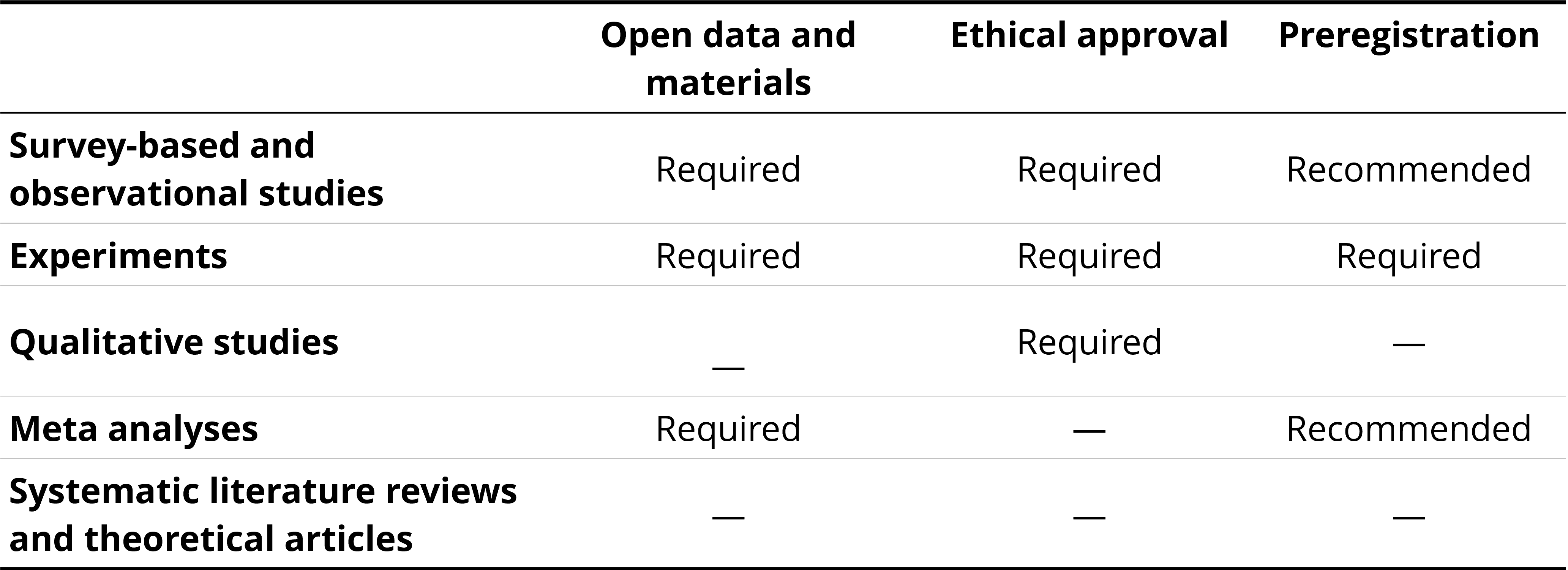
At Cyberpsychology, we are committed to promoting open science principles. To facilitate transparency and reproducibility, we require all submissions of quantitative studies (survey-based, observational, experimental, and meta-analyses) to be accompanied by anonymized data and materials (i.e., codebooks, analytical scripts, outputs, measures, and stimuli) shared via an open repository (e.g., Zenodo).
Data and materials must be shared and documented to an extent that enables full reproducibility. Datasets should be shared in open or accessible formats (e.g., .csv, .tsv, .sav, .RData) and clearly labeled in English via a codebook or data labels. For analyses performed using paid proprietary software (e.g., Mplus, SPSS, Stata), output files must be provided alongside the analytical scripts. During peer review, data and materials must be accessible to editors and reviewers via anonymized links. Upon acceptance, these must be made publicly available via persistent, unblinded links. The information should be presented under the Data Availability Statement in the submission title page(s) (see below). Please note that this requirement is not met when data are available only upon request.
If sharing data or materials is not possible (e.g., due to ethical or legal constraints), authors must request an exemption from the editorial office prior to submission, providing clear and specific justifications. The editorial office may request supporting documentation. Even when an open data exemption is granted, authors are still expected to share all open materials (e.g., scripts, stimuli) alongside aggregated data (e.g., means, SDs, N, variance-covariance matrices). Where full reproduction of the primary analysis is not technically feasible using summary statistics alone, the aggregated data must still be provided to ensure maximal transparency and support future research synthesis. To request an exemption, please email info@cyberpsychology.eu with a clear justification. Use the subject line: "Exemption Request". Editors will review your request and either grant the exemption or decline it, in which case the manuscript cannot be submitted.
Preregistration is mandatory for experimental studies and strongly recommended for observational and survey-based studies. Preregistration must occur prior to data collection or data delivery. For experimental studies, post-data preregistration will not be accepted. For all other study types, any registration completed after data became available must be explicitly stated in the manuscript along with a clear defense of its purpose. Preregistrations must be hosted on an open repository (e.g., AsPredicted, OSF Registries) and specify, at a minimum, the study's hypotheses, design, target sample, measures, and analytical approach. See section 3.5. for more details on what to include in the main text of preregistered studies. The submission may contain unregistered analyses, but these must be labeled as exploratory.
To ensure measurement rigor, submissions must report the psychometric properties of all measures used, computed on the current study data. For scales treated as reflective constructs, authors must report confirmatory factor analysis (CFA) fit indices alongside appropriate reliability estimates. For other types of measures, authors must provide clear justifications supporting their validity and reliability. This applies to both newly created and established or previously validated measures.
2.2. Ethical Approval
All submissions reporting studies involving human participants or human data must state that the relevant Research Ethics Committee (REC) or Institutional Review Board (IRB) approved the study. This requirement applies across research designs, including survey-based and observational studies, experiments, and qualitative studies. The requirement does not apply to meta-analyses, systematic literature reviews, theoretical articles, and submissions that do not involve the collection or analysis of new data from human participants.
The full name and institution of the REC/IRB and the approval number must be reported both on the Title page, and a blinded version should be reported in the Methods section of the manuscript. The document certifying approval must be submitted as a separate file as well.
Example statement for the Title page: This study was approved by the Research Ethics Committee of XXX University (approval number 123-456).
Where relevant, the Methods section of the manuscript should also state whether informed consent was obtained and describe any other ethical considerations relevant to the study, including how participants' rights, privacy, confidentiality, and welfare were protected. Authors should provide sufficient information in the Methods section to demonstrate that the study was conducted in an ethical and responsible manner.
2.3. Language Requirements
It is the authors' responsibility to have their manuscripts proofread before submission. Submissions can be rejected due to language insufficiencies.
2.4. Requirements Summary
3. Submissions and Manuscript Preparation
This section summarizes the journal’s requirements regarding the format, structure, and other aspects of the submission. Please go through these instructions carefully. Not adhering to these requirements can lead to a desk rejection of the article without assessing its quality.
3.1. Length
To facilitate the review process and publication clarity, manuscripts should be no longer than necessary. The submissions should be up to 11,000 words, including abstract, references, tables, figures, and footnotes or endnotes (the length does not include appendices).
The length of articles can be exceeded when justified by the authors (e.g., in case of multiple studies, mixed methods, or in a deep qualitative investigation). Journal’s editors will critically review articles exceeding the recommended length. Authors may be asked to shorten the submission before sending it to external reviewers.
3.2. Manuscript structure and citations format
The American Psychological Association (APA) standards is used for publications, both in terms of publication structure (i.e., IMRaD) and citation style. Please follow the Publication Manual of the American Psychological Association (7ed.). Manuscripts that do not follow the required APA style will be rejected directly by editors.
3.3. Reporting statistics
Follow the Publication Manual of the American Psychological Association (7ed.) standards for reporting statistics, such as reporting exact p-values to three decimals, or not using a zero before a decimal when the statistic cannot be greater than 1.
3.4. Submission files
The required format for articles is MS Word. Do not submit your article, or its revision, as a pdf file.
Authors should prepare the following documents. All documents must be in English. Download title page template here.
3.4.1. Title page(s) with full author information. This document will not be presented to the reviewers, and should include:
- Manuscript’s title
- All authors’ full names, their affiliations and email addresses, identification of the corresponding author and their full address
- Authors’ contributor roles – please use the relevant roles from the CRediT taxonomy (https://credit.niso.org/)
- The disclosure of interests’ statements
- The disclosure of AI usage
- Data availability statement
- Ethical approval statement, including approval number
- Short biographical note for each author
- Acknowledgments
3.4.2. Anonymized main text. See the section “Anonymization of the manuscript” below for information on what to anonymize. The document should include:
- Title page(s). The title page should include the title of the article, the abstract, five to eight keywords, a data availability statement, and the (anonymized) IRB approval, disclosure of interests, and disclosure of AI usage. The title should be concise and accurately depict the manuscript’s content. The abstract should be unstructured (i.e., without subtitles), self-explanatory and reflect the study well. It should not exceed 250 words. The abstract should briefly introduce the study’s focus, design, sample, main findings, and its importance. The disclosure of interest should include any conflicts of interest that the authors might have. Please state these in an anonymized fashion in line with the double-blind review process. If the authors do not have any conflicts of interest, please state so (suggested formulation: “The authors do not have any conflicts of interest to report.”). For information about disclosure of AI usage, see section 4 below.
- The main text. Use Times New Roman font, size 12, with double spacing. The structure of the manuscript should correspond to the APA citation style. The main sections, with Level 1 Heading (bold, centered, title case), are: Introduction, Method, Results, Discussion, and References. Level 2 Heading should be bold, left-aligned, and in title case; Level 3 Headings should be bold italic, left-aligned, and in title case; Level 4 headings should be indented, bold, in title case, ending with a period; and Level 5 Headings should be indented, bold italic, in title case, ending with a period. See https://apastyle.apa.org/style-grammar-guidelines/paper-format/headings for more details.
- Tables, figures, and other visual materials. All tables and images should be named and numbered in Arabic numerals. Place all tables and pictures in the text at the position where they should be placed. All common formats of tables, images, sound, and videos are accepted. Permissions for all formerly published figures such as tables and pictures are required. An author of an article should obtain written copyright permissions from their original holders.
- References list. All sources that are cited in the text must be included in the Reference list. The journal uses the APA citation style. See https://apastyle.apa.org/style-grammar-guidelines/references/examples for guidelines and references examples.
- Endnotes. Endnotes are preferred over footnotes. However, please limit the number of endnotes to a minimum.
- Appendices. Appendices are included at the end of the document. They are optional and do not count to the recommended manuscripts’ length. Unless it violates third-party rights, share the full list of items in the Appendix.
3.4.3. Supplementary materials. These materials (e.g., supplementary tables / figures / audio files / video files) are optional and can be included via URL to an anonymized version of the documents on a secure open repository (e.g., Zenodo).
3.4.4 Ethical approval. Submit documentation certifying approval from the relevant REC/IRB (see requirements above).
3.5. Preregistered Studies
Make sure that the manuscript containing the preregistered study includes:
- URL to the anonymized version of the preregistration (this could be in the Introduction, Methods, or Results)
- A clear indication of which parts of the study were preregistered (e.g., data collection procedure, hypotheses, measures, tested model)
- A clear indication of which tested hypotheses were preregistered and which (if any) were not
- A clear (but concise) description of the differences between the preregistration and the manuscript (e.g., differences in conceptualization/measurement of a tested construct, in conducted analysis, in data collection), or an explicit statement that preregistered procedures were all followed (please note that detailed description of the changes should be included in 'transparent changes' document as part of OSF documents)
3.6. Anonymization of the Manuscript
3.6.1. Replacing identifying self-citations. “Identifying self-citations” are references from which a reviewer can recognize the authors of the submitted manuscript based on the context in which they are used. For instance, a sentence “In a previous study, we suggested that…. (Smith & Clark, 2010)“ contains an identifying self-citation. On the other hand, a sentence “In a study by Smith and Clark (2010), the authors suggest that…” contains a non-identifying citation, because the reviewer is unable to tell that Smith and Clark are the authors of the submitted manuscript. To ensure the double-blind review, identifying self-citations must be replaced. In-text citations of such identifying self-citations should be replaced by “AUTHOR, 2010” (e.g., “In a previous study, we suggested… (AUTHOR, 2010)”) and the source in the Reference list should be replaced by “AUTHOR (2010). Blinded for review purposes,” and placed at the beginning of the Reference list. Non-identifying self-citations, on the other hand, are not replaced and remain un-anonymized.
We recommend using non-identifying self-citations where possible because the referred-to work may contain crucial information (e.g., for justification of the conducted study) for the reviewer to properly evaluate the submitted manuscript.
3.6.2. Replacing other identifying information. Other information that might lead reviewers to recognize the authors might include, for instance, the name of the institute or university where the study was conducted/approved, or the project name. Please, replace all such information (e.g., “the project (blinded for the review).”).
3.6.3. Removing author information from the document metadata. The document may keep the information about authorship in its metadata. See the guidelines for the removal in MS Word here.
4. Usage of AI
Cyberpsychology distinguishes two broad uses of AI tools: generative and assistive.
- Generative AI use entails generating content (e.g., text, figures, images, code) typically using large language models (e.g., ChatGPT, MS Copilot, Gemini, Midjourney, DALL-E). Any generative AI use must be disclosed; authors must clearly describe which AI tool was used and how it was used. We strongly recommend authors keep documentation of their AI use as they may be asked for details (e.g., specific prompts) during the review process.
- Assistive AI use typically entails grammar correction, editing enhancements, or code debugging. Common examples include using the integrated grammar-checking tools in MS Word, extensions like Grammarly, or assistive coding tools such as GitHub Copilot. This use of AI tools is common practice and generally does not need to be disclosed.
In both types of use, authors remain fully responsible for the originality, integrity, and factual accuracy of all parts of the submitted manuscript, including those produced or modified by AI tools. Authors also remain liable for any breach of publication ethics. It is also the responsibility of the authors to ensure that their use of AI tools complies with the respective tools' terms of service.
AI tools cannot be listed as (co-)authors nor cited as authors because they do not meet the requirements for authorship, cannot take responsibility for the generated work, and cannot assert the presence or absence of conflicts.
Statement on the Use of AI Services. Please include a section titled “Use of AI Services” on both the no-anonymized title page(s) and the anonymized main text. Place it under the declaration of Conflict of interest. This statement should briefly describe how you used AI services when producing the manuscript. You can use the following sample statements as they are or edit them to accurately describe your use.
Sample Statements:
-
"The authors declare they have not used any AI services to generate or edit any part of the manuscript or data."
-
"The authors declare they have used AI services, specifically [provide a list here], for grammar correction and minor style refinements. They carefully reviewed all suggestions from these services to ensure the original meaning and factual accuracy were preserved."
-
"The authors declare they have used AI services, specifically [provide a list here], to generate or edit parts of our analytical script. They carefully reviewed the script to ensure its correctness."
-
The authors declare they have used AI services, specifically [provide a list here], to generate or edit parts of our stimuli. They carefully reviewed the script to ensure its correctness."
5. Manuscript Submission
Log in the journal's system, click on New submission and follow provided instructions.
If you already have a reviewer account, log in, go to „User“ tab, select „Edit profile“, scroll down, and tick the option „Roles: Author".
6. Review Process
Submitted articles are first reviewed internally by editors to assure their baseline quality and relevance for the journal. In the next step, submissions are subjected to a double-blind peer review by at least two external reviewers (authors and reviewers are anonymous to each other). Reviews are forwarded to authors along with the editor's decision. Invited revisions are sent to the original reviewers for their re-evaluation.
The typical review process takes from 3 to 6 months (average 4 months), but can be longer under special circumstances. See this News post for further information about decisions (e.g., desk reject rates, initial decision length). To avoid editorial rejections, please read editorials How to increase probability of manuscript acceptance and How to get your manuscript accepted where we described typical reasons for editorial rejects and the best practices to get your manuscript accepted.
7. Publication of Accepted Manuscripts
All accepted manuscripts are published as open access articles. Publishing in Cyberpsychology is free of charge (no article processing charge or submission fee).
The papers are typically published within 1 to 3 months since acceptance of the paper.
8. Publication Ethics and Publication Malpractice Statement
Cyberpsychology follows the standard for Ethics and Publication Malpractice set by the Committee on Publication Ethics (COPE). Authors, reviewers, editors, and publisher are expected to conform to these standards.
To detect possible plagiarism in submitted articles, Cyberpsychology uses the Similarity check by iThenticate.
9. Publisher
The Journal is published by the Faculty of Social Studies, Masaryk University, Joštova 10
602 00, Brno, Czech Republic, fax: +420 5 4949 1920, e-mail: info@cyberpsychology.eu
Copyright Notice
By submitting a manuscript and/or its subsequent revision(s) (hereinafter referred to as the “Work”) into the Cyberpsychology: Journal of Psychosocial Research on Cyberspace (https://cyberpsychology.eu/) (hereinafter referred to as the “Journal”) for the consideration for publication, the author grants the Masaryk University (hereinafter referred to as “MUNI”) a license to the Work, under the following conditions:
1. Author’s Statements
1.1 The author declares that the Work is free of copyright or other legal defects, it was neither published anywhere else, nor simultaneously offered for publication, except the platforms of standard scientific pre-submission communications (e.g. SSRN, ResearchGate, Academia).
1.2 The author declares that he/she is the real author or the joint author of the Work and his/her freedom to grant the license is not limited or excluded, and the author is entitled to dispose of the Work, because especially, but not limited to:
- the Work is not an Employee work where the employee would not be entitled to exercise the rights to the Work,
- using of the Work within the scope of the granted license is not limited by the conditions of provided grant or other financial support
- using of the Work within the scope of the granted license is not limited by the third parties’ rights (e.g. copyright, the right to the protection of personal data),
- the Work is not the work of joint authors, where the other joint authors would not agree to grant the license.
1.3 In the case that the Work is the work of joint authors, the author declares that all the joint authors have been informed of these License Terms and that he/she is authorized to grant MUNI the license under these License Terms on behalf of the joint authors.
1.4 The author agrees that if the Work is accepted for publication, the proposal to conclude a license agreement for the Work will be on his/her behalf aimed at an indefinite number of persons, while the content of the agreement will be determined by reference to the publicly available licence conditions Creative Commons BY-SA 4.0 International (available from: https://creativecommons.org/licenses/by-sa/4.0/); such proposal will not be done for the works or the elements (e.g. image or photographic documentation) used by the author in the Work under a contractual license with a third party.
1.5 If any of the author’s statements prove to be untrue, the author is aware that he/she is liable for the resulting damage, including the costs associated with any litigation and damage caused by a violation of the Journal’s and/or MUNI’s reputation.
2. License Grant
2.1 The author grants MUNI gratuitous non-exclusive license to use the Work in all the known manners of use (especially, but not limited to, reproduction, distribution and communication to public), individually, in the collection or together with any other works or elements unlimited as regards to amount and form and media of expression (including electronic).
2.2 The license is granted as territorially and quantitatively unlimited.
2.3 The license is granted royalty-free.
2.4 The license is granted for the duration of economic rights to the Work.
2.5 MUNI shall be entitled to grant an authorisation forming part of the licence to the third party or parties, in whole or in part under a sublicense agreement, with or without remuneration.
2.6 By granting the license, the author agrees with including the Work into the scientific and bibliographical databases (eg. EBSCO, CEEOL) as well as information systems for providing the informational services, where the Journal is currently indexed as well as those, where it will be indexed pro futuro.
2.7 MUNI shall be not obliged to make use of the license.
3. Further Use of Work
3.1 Given granted the non-exclusive license to the Work, the author shall be entitled to further use the Work. For the purpose of such further use of the Work, the author shall be obliged to state the Journal as the source of publication of the Work.
3.2 In the case of disclosure of the Work on the platforms of standard scientific pre-submission communications within the meaning of Art. 1.1, the author shall be obliged to additionally state the Journal as the source of publication of the Work, without undue delay.
3.3 The reputation of MUNI and/or Journal shall not be negatively affected by the further use of the Work.
4. Varia
4.1 Legal relations based on the license shall be governed by the laws of the Czech Republic; any disputes arising out of the license shall be settled by the courts of the Czech Republic.
4.2 If the Work is rejected for publication in the Journal, the license shall be, at the moment of the decision of rejection, restricted in such a way that it shall cover use of Work only in the necessary extent within related editorial activities (e.g. review and archiving).
Privacy Statement
See our privacy statement here.